.webp&w=2048&q=75)
.webp&w=2048&q=75)
Essential info at a glance
| Detail | At a glance |
|---|---|
| What it is | A serene Tibetan Buddhist monastery and temple at Sarnath, among the first Tibetan monasteries built in India. |
| Opening hours | 6:00 AM to 6:00 PM, every day. |
| Entry fee | Completely free. |
| The main image | A beautiful golden statue of Shakyamuni Buddha. |
| Prayer wheels | Large prayer wheels that spread a sacred mantra when turned clockwise. |
| The art | Colourful Thangkas, Tibetan scroll paintings, and frescoes on the walls and ceilings. |
| The pink stupa | A light-pink stupa built by the Tibetan community in gratitude to India for their refuge. |
| Location | Sarnath, about 10 km from the city, close to the Sarnath Archaeological Museum. |
Tibetan Temple timings
The temple is open every day from 6:00 AM to 6:00 PM, and entry is completely free. It is a calm, colourful and deeply atmospheric place, and about half an hour to forty-five minutes is enough to take it in peacefully, longer if you wish to sit quietly in the prayer hall.
| Detail | When | Notes |
|---|---|---|
| Opening hours | 6:00 AM to 6:00 PM | Open every day of the week. |
| Entry fee | Free | No ticket is needed. |
| Time needed | About 30 to 45 minutes | For the temple, the prayer wheels and the stupa. |
| Best season | October to March | The most pleasant weather for Sarnath. |
The Tibetan Temple: a home of Tibetan Buddhism at Sarnath
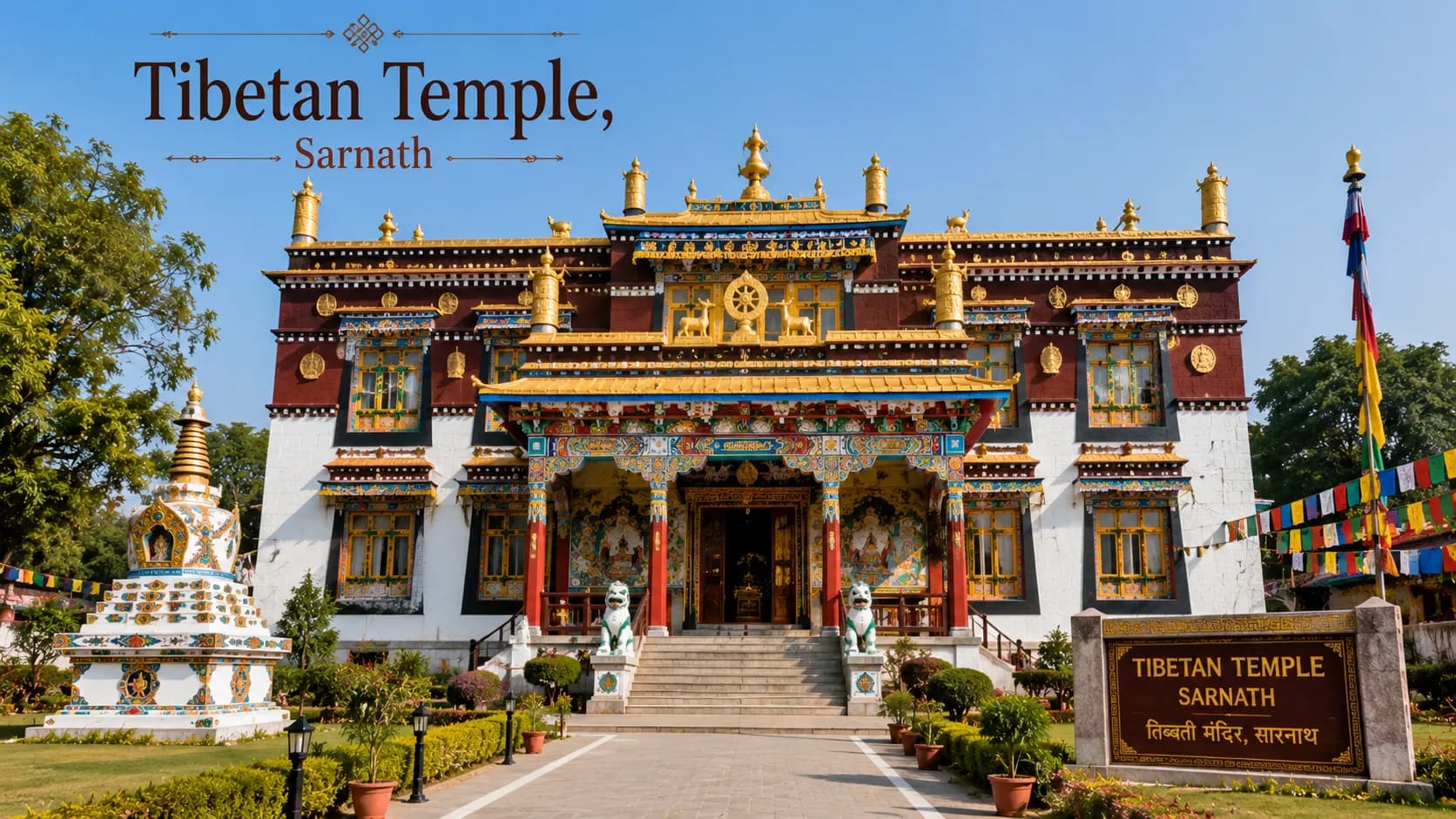
Of all the temples that the Buddhist nations have raised at Sarnath, the Tibetan Temple is among the most colourful and the most moving. It is a monastery in the full Tibetan tradition, the Vajrayana, and it is remembered as one of the very first Tibetan monasteries built in India, closely associated with His Holiness the Dalai Lama and the great community of Tibetans who made their home in India. Its entrance is flanked by two carved lions, and within, its walls and ceilings blaze with colour, laden with Tibetan paintings, so that stepping inside is like stepping into the high monasteries of the Himalayas.
At the heart of the temple sits a beautiful golden image of Shakyamuni Buddha, the historical Buddha, gilded and serene, before which butter lamps burn and monks and pilgrims offer their prayers. It is a living, working monastery, and its quiet devotion, so different in flavour from the Hindu temples of Kashi across the river, gives it a gentle, otherworldly peace.
The prayer wheels, and the wheel of Dharma
Around the temple stand rows of prayer wheels, the mani wheels of Tibetan Buddhism, and turning them is one of the most beautiful things a visitor can do here. Each wheel is a cylinder holding a tightly wound scroll on which a sacred mantra, above all Om Mani Padme Hum, the great prayer of compassion, is printed many thousands of times, and to turn the wheel clockwise is, in the tradition, to send that prayer out into the world, as if reciting it countless times over. At this temple, some of the wheels even release little printed paper scrolls of the chant as they spin.
There is a special beauty to spinning a prayer wheel here of all places, for the very word for it means turning the wheel of Dharma, and Sarnath is the place where the Buddha first turned that wheel, when he preached his first sermon and set his teaching in motion. So to turn a prayer wheel at Sarnath is to echo, with your own hand, the great beginning that happened here. Turn them gently, clockwise, as the pilgrims do, and let the prayer go out.
The Thangkas and the frescoes
The Tibetan Temple is famous, too, for its art. Its walls and ceilings are adorned with Thangkas, the exquisite Tibetan scroll paintings, and with frescoes, glowing with colour and gold, depicting the Buddha, the great teachers, the deities and the mandalas of Tibetan Buddhism. These are not mere decoration; each is a window into the teaching, a map of the spiritual world, painted according to precise and ancient rules. Sarnath is one of the living homes of this sacred art, taught to young monks at the great Central Institute of Higher Tibetan Studies nearby, so the tradition here is not a museum piece but a craft still practised and passed on. Take your time with them, and do not touch, for the oils of the hand harm the delicate old pigments and gold.
The pink stupa: a gift of gratitude
In the open compound of the temple stands a light-pink stupa, and its story is one of the most touching in all of Sarnath. It was built by the Tibetan community as a heartfelt gesture of gratitude to India, for the refuge that India gave to His Holiness the Dalai Lama and to the many thousands of Tibetans who came here seeking a home, and it stands also in remembrance of those who suffered in Tibet. In its gentle pink form, it speaks of thankfulness, of friendship between two ancient peoples, and of a community that, far from its own land, found a welcome in the country where the Buddha himself once walked. Many visitors find it quietly affecting, and walk a slow, respectful circle around it, clockwise, as is the custom.
A living Tibetan Sarnath
The temple is part of a larger, living Tibetan presence at Sarnath. Nearby stands the Central Institute of Higher Tibetan Studies, a great seat of Tibetan learning, philosophy and art, and other Tibetan monasteries and study centres, so that Sarnath has become one of the most important homes of Tibetan Buddhism outside the Himalayas. To visit the temple is to touch that living world, where the teaching that began at Sarnath so long ago is studied and kept alive by a people who have carried it far.
A window into the Himalayas, in my own words
By Rajeev Sharma, Varanasi local
The Tibetan Temple is one of my favourite surprises to give travellers at Sarnath, because inside it feels like the Himalayas, all that colour, the golden Buddha, the paintings covering every wall. I show my guests the golden Shakyamuni Buddha, and then I take them to the prayer wheels, and I tell them the lovely thing, that turning a prayer wheel means turning the wheel of Dharma, and that Sarnath is the very place where the Buddha first turned that wheel. So I have them spin the wheels, clockwise, and send out the prayer, right where it all began. People love that.
And then I bring them to the pink stupa, and I tell them, gently, that the Tibetan people built it to thank India for giving them shelter, and my guests are always moved by that, this quiet monument of gratitude. I explain the Thangkas, and remind them not to touch, and to keep silence, because it is a working monastery and monks are at prayer. In the middle of Hindu Kashi, this little piece of Tibet is a beautiful, peaceful thing to share, and travellers of every background feel it.
In more than forty years of guiding, this is where I most often see a traveller step, for a moment, into another world.
, respecting any restrictions inside the prayer hall.]*
What to see and do
- Bow before the beautiful golden statue of Shakyamuni Buddha in the prayer hall.
- Turn the prayer wheels clockwise, and send out the mantra of compassion, at the place where the Buddha first turned the wheel of Dharma.
- Admire the Thangkas and the glowing frescoes on the walls and ceilings.
- Visit the pink stupa of gratitude and walk a quiet circle around it.
- Sit awhile in the calm, colourful atmosphere of a living Tibetan monastery.
How to reach the Tibetan Temple
The temple is in Sarnath, close to the Archaeological Museum and the ancient ruins, about 10 km from the city and roughly 1 km from Sarnath railway station, on the northern, airport side of Varanasi. It is easy to reach by road, within 25 to 45 minutes from the city.
| From | Distance | Notes |
|---|---|---|
| Sarnath Archaeological Museum and the ruins | Very close | See them together on a Sarnath visit. |
| Sarnath railway station | About 1 km | A short ride. |
| Varanasi city | About 10 km | By auto, cab or local bus, 25 to 45 minutes. |
| Airport | About 20 km | Sarnath is on the airport side; easy to pair with an arrival or departure. |
It is best seen as part of a Sarnath visit. See our guide to Sarnath. We arrange the transport, timing and a guide, and take you to every temple you want to see.
Best time to visit and how to plan it
| When | Why |
|---|---|
| October to March | The most pleasant weather for Sarnath and its temples. |
| Morning or late afternoon | Cool and calm, with the temple at its most peaceful. |
| Losar (Tibetan New Year, around February) | The Tibetan community celebrates, and the temple is especially vibrant. |
| As part of a Sarnath day | Combine it with the museum, the ruins and the other international temples. |
- Pair it with the Sarnath monuments, the Sarnath Archaeological Museum and the other international temples for a full day.
- Allow 30 to 45 minutes for the temple, the wheels and the stupa.
For Sarnath planned as one route, see our Varanasi tour packages.
Etiquette for visiting
- This is a working monastery; keep silence, move gently, and do not disturb the monks or those at prayer.
- Dress modestly, covering shoulders and knees, and remove your footwear before entering the prayer hall.
- Turn the prayer wheels clockwise, and walk clockwise around the stupa, as is the tradition.
- Do not touch the Thangkas, frescoes or statues, and ask before photographing inside the prayer hall.
Accessibility for elderly and mobility limited visitors
- The temple grounds are largely level and reachable by road, easier than the old city.
- There are a few steps into the prayer hall; the prayer wheels and the stupa are at ground level.
- It is calm and unhurried, which suits a gentle, seated, contemplative visit.
- We arrange transport to the temple and plan the Sarnath visit so a senior guest is comfortable.
Nearby sites to combine with your visit
The Tibetan Temple is in the international temples area of Sarnath, on the northern, airport side of the city.
| Site | What it is | Internal link |
|---|---|---|
| Sarnath (Dhamek Stupa and site) | The great Buddhist site where the Buddha gave his first sermon. | /temple/varanasi/sarnath |
| Sarnath Archaeological Museum | The oldest site museum in India, home to the Lion Capital of Ashoka, close by. | /temple/varanasi/sarnath-archaeological-museum |
| Thai Temple (Wat Thai) | The Thai temple with its giant 80-foot standing Buddha and gardens. | /temple/varanasi/thai-temple-sarnath |
| Mulagandha Kuti Vihar | The beautiful modern Buddhist temple with the frescoes and relics. | /temple/varanasi/mulagandha-kuti-vihar |
| Chaukhandi Stupa | The stupa marking the Buddha's meeting with his first disciples. | /temple/varanasi/chaukhandi-stupa |
For the grand evening Ganga aarti back in the city, see our Varanasi tour packages.
Our guided Sarnath and international-temples visits
We are a Varanasi based operator, a unit of Experience My India, with more than forty years of guiding travellers across Kashi, Sarnath, Ayodhya, and Prayagraj. The temple is free, so what we arrange is an honest, well-planned Sarnath visit: transport, timing, and a guide who explains the Tibetan tradition, the prayer wheels and the Thangkas, and takes you to the other international temples and the whole Sarnath site, with no rushing and no shop diversions, easily combined with an airport arrival or departure.
| Experience | Includes | Price |
|---|---|---|
| Sarnath half-day tour | The Tibetan Temple, the Dhamek Stupa, the Mulagandha Kuti Vihar, the museum and more, with a guide. | Contact us for pricing |
| International temples of Sarnath | The Tibetan, Thai, Japanese and other temples, with a guide. | Contact us for pricing |
| Airport-side Sarnath visit | Sarnath on your arrival or departure day, with the Tibetan Temple. | Contact us for pricing |
| Kashi and Sarnath day | The Buddhist Sarnath with the Hindu heart of Kashi. | Contact us for pricing |
Inclusions and exclusions are stated up front, with any taxes and conditions, and no charge appears later that was not named. We never divert you to shops. See all our Varanasi tour packages for the full range.
Experience My India is a travel operator, not the temple administration. Our guiding and transport are ours; the temple is a Tibetan monastery, and entry is free. Timings and arrangements can change.