Essential info at a glance
| Detail | At a glance |
|---|---|
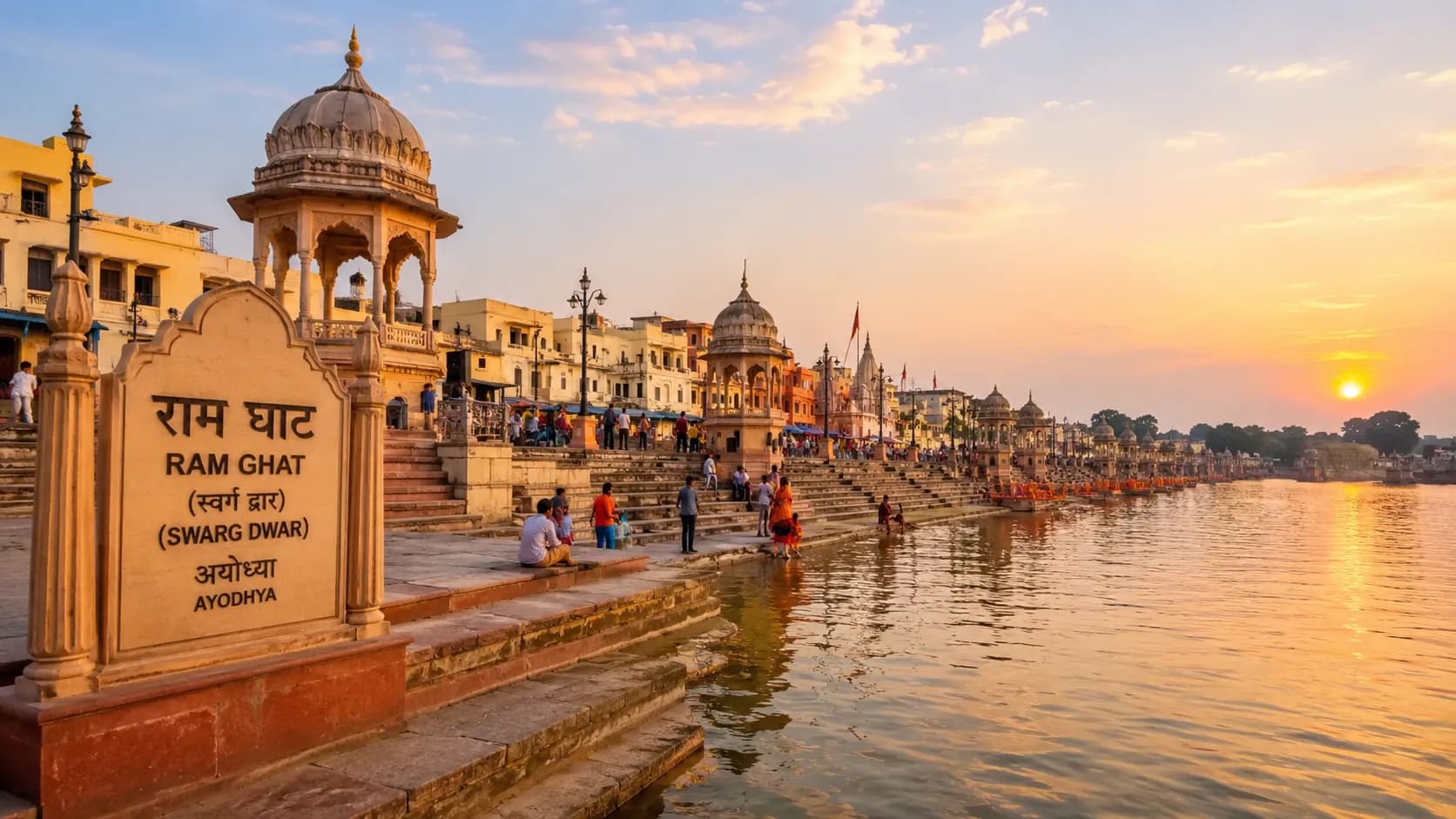
| What it is | Ram Ghat, also Swarg Dwar, the Gateway to Heaven, the ancient principal ghat of Ayodhya on the Saryu. |
| Significance | Associated with Lord Ram's legacy; a sacred ground of the holy dip, ancestral rites and the last rites. |
| Ghat access | Open daily 4:00 AM to 10:00 PM for the holy dip and the riverside. |
| Entry fee | Free. No ticket or VIP pass. |
| Saryu aarti | Held daily at the ghats nearby, around 6:00 to 7:30 PM; peaceful, with close seating. |
| Ancestral rites | Pind daan and tarpan are performed here by the ghat priests, for the departed and one's lineage. |
| Visit | With reverence; a place of sanctity, not a spectacle. |
| Location | Near Nageshwarnath and the Ram Katha Park area, Ayodhya. |
Ram Ghat timings and the aarti
Ram Ghat is open every day from 4:00 AM to 10:00 PM, for the holy dip and for walking the riverbank, and it is free. The grand Saryu aarti is performed daily at the ghats nearby, around 6:00 to 7:30 PM, peaking around 6:30 to 7:00 with the sunset; and, unlike the vast Ganga aarti of Varanasi, the Saryu aarti here is peaceful and intimate, allowing close seating, though on peak days it is still wise to arrive thirty to forty-five minutes early. The early morning is the loveliest time for the holy dip and the quiet of the riverbank. For the full guide to the aarti, see our Saryu aarti and Ram ki Paidi page.
| Detail | When | Notes |
|---|---|---|
| Ghat access and the dip | 4:00 AM to 10:00 PM | For the holy dip and the riverbank; free. |
| Saryu aarti (nearby) | Around 6:00 to 7:30 PM | Peaceful and intimate; arrive early on peak days. |
| Best times | Early morning | For the holy dip and the quiet riverbank. |
| Entry fee | Free | No ticket or VIP pass. |
Ram Ghat and Swarg Dwar: the Gateway to Heaven
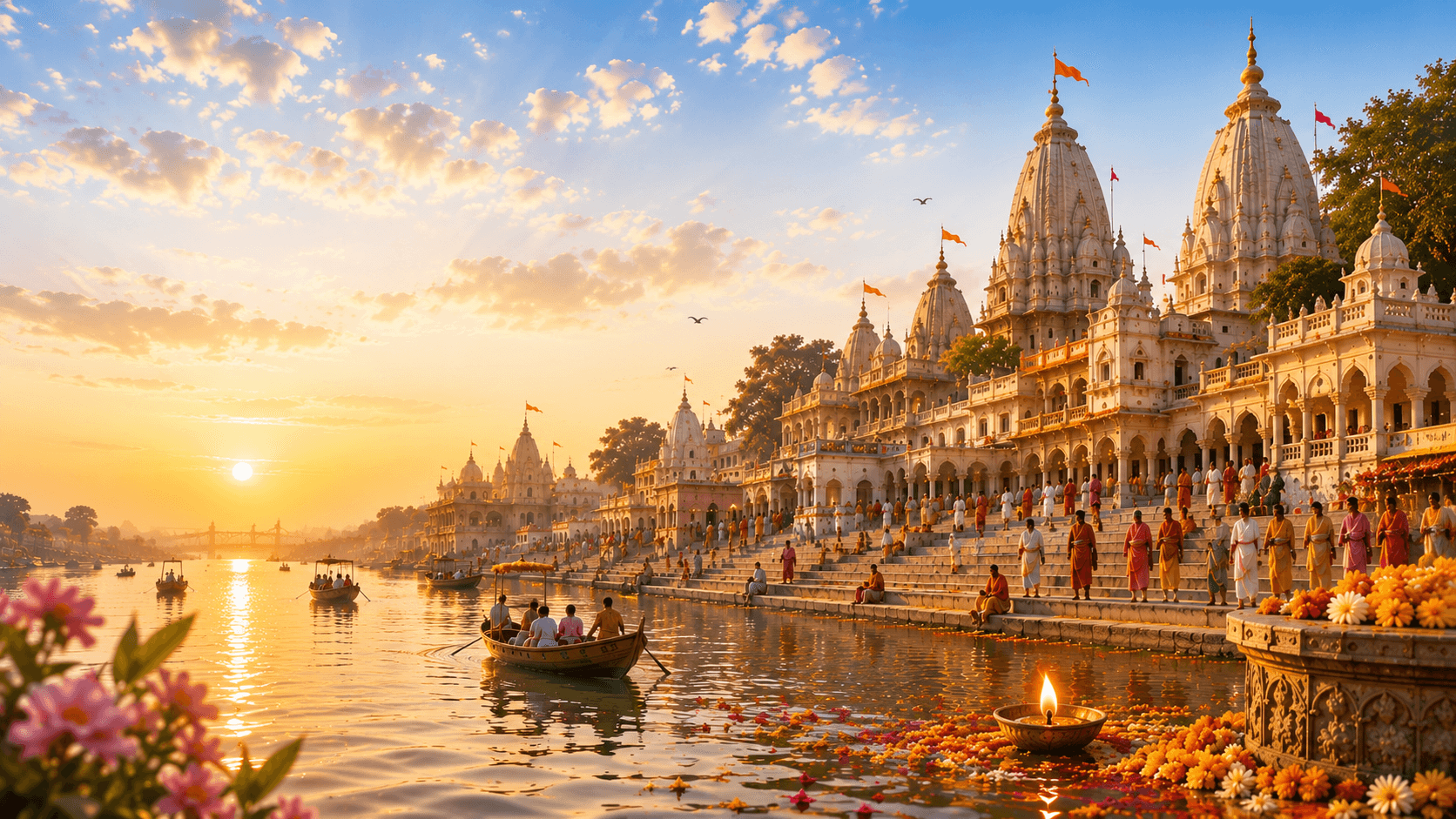
Ram Ghat is one of the most ancient and sacred of all the ghats of Ayodhya, known also, and most tellingly, as Swarg Dwar, the Gateway to Heaven. This is the historic principal ghat of the holy city, the long, revered strip of riverbank that runs from Sahastradhara to the ancient Nageshwarnath temple, only half a kilometre from the Ram Janmabhoomi; and here, since the age of the Ramayana itself, the Treta Yuga, pilgrims and sages have come to the sacred Saryu for the holy dip and the rites of the soul. The ghats and their fine riverside buildings were raised in their present form over the centuries, some in the Nawabi era, and rebuilt again when the river shifted its course; and to this day Swarg Dwar is a place of the deepest and most solemn sanctity in Ayodhya, bound up with the very passage of the soul to the divine.
The door to heaven: the passage of the soul
The name Swarg Dwar, the Gateway to Heaven, tells the deepest meaning of this ghat: it is revered as a door through which the soul may pass to the heavenly realm. For Swarg Dwar is the sacred ground of Ayodhya's last rites, where, from ancient times, the departed have been given to the holy fire and the sacred river, that their souls might cross to the divine; and tradition holds that here, at the end of his earthly reign, the final rites of Lord Ram himself and of his kin were performed. To die and be given one's last rites at such a place, at the very gateway to heaven in the city of Ram, is held to be a great blessing and a release. It is a solemn, holy, and profoundly moving place, kept with the deepest reverence; and though it is a ground of grief, it is also a ground of hope, of the soul's return to God. It is Ayodhya's own gateway of liberation, akin to the great Manikarnika of Kashi.
Lord Ram's ghat and the holy dip
For all its solemnity, Swarg Dwar is also a living, sacred bathing ghat, woven into the daily life of Lord Ram himself. The tradition tells that Ram, in his years as king of Ayodhya, would come down to the Saryu to take his holy bath each day, and, after bathing, would give cows and gifts in charity and honour the learned; and that before he set out for his fourteen years of exile, he took his dip in these sacred waters. And so the pilgrim who comes here to take the holy dip, the Saryu snan, believed to wash away the sins of many lifetimes, follows in the very footsteps of the Lord. To bathe at Swarg Dwar, in the river of Ram, at the gateway to heaven, is among the most purifying acts a pilgrim can perform in Ayodhya.
Ancestral rites at Swarg Dwar
Because it is the Gateway to Heaven, Swarg Dwar is above all a place for the rites of the ancestors, and pilgrims come here to perform the pind daan and the tarpan, the sacred offerings by which one honours and gives peace to the souls of one's departed forebears. These rites are performed by the ghat priests according to the ancient tradition, and to make them here, at the gateway to heaven in the city of Ram, is held to bring the deepest blessing to one's lineage. If you wish to perform ancestral rites, we can help you arrange them respectfully with the priests of the ghat.
The two gateways: Swarg Dwar and Manikarnika
For a pilgrim who knows both the holy cities, there is a deep and moving kinship between Swarg Dwar of Ayodhya and Manikarnika of Kashi, the two great gateways of the soul. At Manikarnika, on the Ganga in Shiva's city, and here at Swarg Dwar, on the Saryu in Ram's city, the departed are given to the sacred fire and the holy river to cross to liberation; both are grounds of the profoundest sanctity, where grief and hope, death and release, meet at the water's edge. To have stood in reverence at both is to have touched the deepest mystery of our tradition, the passage of the soul, in the two holiest of the river cities.
The gateway to heaven, in my own words
By Rajeev Sharma, guide with Experience My India
I bring my guests to Ram Ghat, Swarg Dwar, with a quiet heart, because it is a solemn, holy place, not a sight to be gawked at. I explain to them, gently, that its name means the Gateway to Heaven, and that it is the ancient main ghat of Ayodhya, the sacred ground of the last rites, where the departed are given to the river and the fire to cross to the divine, as tradition says Lord Ram's own last rites were. I ask them to be respectful, to be quiet, and never to photograph the funeral rites. People feel the deep sanctity of it at once.
Having spent my life on the ghats of both Kashi and Ayodhya, I always tell my guests the moving thing: that this Swarg Dwar of Ram's city is the sister of Manikarnika of Shiva's city, the two great gateways of the soul. And I tell them the beautiful other side of it too, that this is where Lord Ram bathed each day as king, so that to take the holy dip here is to follow the Lord himself. For those who wish, I help them arrange the ancestral rites with the priests, quietly and properly. It is a profound, sacred, humbling place, and I bring pilgrims to it with reverence.
How to visit with reverence
- Come quietly and respectfully; this is a sacred ground of the last rites, not a spectacle.
- Do not photograph any funeral rites or the mourners; be discreet with your camera everywhere here.
- Take the holy dip with devotion, at the bathing steps, dressed modestly.
- If you perform ancestral rites, do so with the ghat priests, in the proper and respectful way.
- Keep your voice low, give way to those in grief, and hold the place in reverence.
How to reach Ram Ghat
Ram Ghat, Swarg Dwar, is on the Saryu near the ancient Nageshwarnath temple and the Ram Katha Park area, close to the core of the city, and easily reached by local auto or e-rickshaw from Ayodhya Dham Junction.
| From | Distance | Notes |
|---|---|---|
| Nageshwarnath Temple | Adjacent | The Swarg Dwar strip runs to Nageshwarnath. |
| Ram Janmabhoomi Mandir | About half a km | By foot or e-rickshaw. |
| Ram Katha Park and Ram ki Paidi (the aarti) | Nearby, on the riverfront | The cultural park and the aarti ghats. |
| Ayodhya Dham Junction (railway) | A few km | By e-rickshaw, auto or taxi. |
| Maharishi Valmiki Airport, Ayodhya | About 12 km | The new airport; taxis and autos to the ghat. |
It is close to the riverside temples and the aarti ghats.
Best time to visit and how to plan it
| When | Why |
|---|---|
| Early morning | For the holy dip and the quiet, reverent riverbank. |
| Around the evening aarti (nearby) | The peaceful Saryu aarti at the nearby ghats. |
| Kartik Purnima (Nov) | The greatest day for the holy dip in the Saryu. |
| Pitru Paksha and ancestral occasions | For the pind daan and tarpan, the rites of the ancestors. |
- Pair it, respectfully, with the riverside temples and the Saryu aarti.
- Allow time for a quiet dip and, if you wish, the ancestral rites; do not rush.
For Ayodhya, or a combined Kashi and Ayodhya pilgrimage, planned end to end, see our tour packages.
Accessibility for elderly and mobility limited visitors
- Ram Ghat is a riverside ghat with steps; the upper areas are easier, and it is best visited slowly and calmly.
- For the holy dip, the steps need care; a helping hand is wise, and we assist elderly pilgrims.
- The ghat priests and our guide can arrange a comfortable, reverent visit and the rites, seated as needed.
- We arrange transport and plan a gentle, respectful visit within your Ayodhya day.
Etiquette at the ghat
- Hold the place in reverence; it is a sacred ground of the last rites.
- Never photograph funeral rites or mourners; be discreet everywhere here.
- Dress modestly, especially for the holy dip; changing spots are available at the ghats.
- Do not litter or put plastic in the river; keep quiet and give way to those in grief.
Our guided visits and ancestral rites
We are a Varanasi and Ayodhya based operator, a unit of Experience My India, with more than forty years on the river ghats of Kashi and Ayodhya, and our own local guide and pandit in Ayodhya. The ghat and the holy dip are free, so what we offer is a respectful, well-guided visit: a guide who tells the meaning of Swarg Dwar with reverence, help to take the holy dip, and, for those who wish, the arrangement of the ancestral rites, the pind daan and tarpan, with the priests of the ghat, done properly and with dignity.
| Service | Includes | Price |
|---|---|---|
| Guided Saryu ghats visit | A reverent, guided visit to Swarg Dwar and the riverside, with a guide. | Contact us for pricing |
| Ancestral rites arrangement | Help to perform pind daan and tarpan with the ghat priests, respectfully. | Contact us for pricing |
| Full Ayodhya darshan | The riverside within a wider Ayodhya visit, with a guide. | Contact us for pricing |
| Kashi and Ayodhya sacred pilgrimage | The sacred ghats of both cities, with darshan and transfers. | Contact us for pricing |
Inclusions and exclusions are stated up front, with any taxes and conditions, and no charge appears later that was not named. The ghat, dip and aarti are free; our charge is only for guiding and for arranging the rites. See all our tour packages for the full range.
Experience My India is a travel operator, not a temple or government body. The ghat, the holy dip and the aarti are free; the ancestral rites are performed by the ghat priests, and our charge is only for our guiding and arrangements. This is a sacred last-rites ground; we ask all visitors to treat it with reverence.
Nearby sacred sites in Ayodhya
Ram Ghat, Swarg Dwar, is on the ancient riverfront, among the sacred sites of Ayodhya.
| Site | What it is | Internal link |
|---|---|---|
| Nageshwarnath Temple | The ancient guardian Shiva temple, adjacent to the Swarg Dwar strip. | /temple/ayodhya/nageshwarnath-temple |
| Guptar Ghat | The departure ghat of Lord Ram, where he entered the Saryu, downstream. | /temple/ayodhya/guptar-ghat |
| Saryu Aarti and Ram ki Paidi | The grand Saryu aarti and the sacred riverfront, nearby. | /temple/ayodhya/saryu-ghat-aarti |
| Lakshman Ghat | The departure ghat of Lakshman, Ram's brother. | /temple/ayodhya/lakshman-ghat |
| Manikarnika Ghat (Varanasi) | The great liberation ghat of Kashi, the sister gateway of the soul. | /temple/varanasi/manikarnika-ghat |
For the Ram Mandir darshan and its free Sugam booking, see our Ram Janmabhoomi Mandir guide.