
Essential info at a glance
| Detail | At a glance |
|---|---|
| What it is | A cultural memorial and museum dedicated to Goswami Tulsidas, the 16th-century poet-saint who composed the Ramcharitmanas. |
| Museum timings | 10:00 AM to 9:00 PM; closed on Mondays and the second Sunday of every month. |
| Daily Ramleela | A live Ramleela is performed every evening, 6:00 PM to 9:00 PM, all year round. |
| Library | 10:30 AM to 4:30 PM; a great store of Ram and Ramayana literature. |
| Entry fee | Completely free for all visitors. |
| Also here | The Ayodhya Shodh Sansthan research institute and the Ram Katha museum. |
| Built | In 1969, on the initiative of the then Governor of Uttar Pradesh. |
| Location | National Highway, Rajgang Crossing, New Colony, Ayodhya. |
Tulsi Smarak Bhawan timings
The Bhawan is open through the day and into the night, and entry is free, but note that the museum is closed on Mondays and on the second Sunday of every month, so plan around that. Its great highlight, the live Ramleela, is performed every single evening from 6:00 to 9:00 PM, so an evening visit is the most rewarding of all.
| Section or activity | Timing | Notes |
|---|---|---|
| Museum | 10:00 AM to 9:00 PM | Closed Mondays and the second Sunday of every month. |
| Daily Ramleela | 6:00 PM to 9:00 PM, every evening | A year-round live enactment; the main highlight. |
| Library | 10:30 AM to 4:30 PM | Rare manuscripts and Ram and Ramayana literature. |
| Office | 10:00 AM to 5:00 PM | For the Ayodhya Shodh Sansthan and enquiries. |
*Entry is free.
Tulsi Smarak Bhawan: a memorial to the poet of the Ramcharitmanas
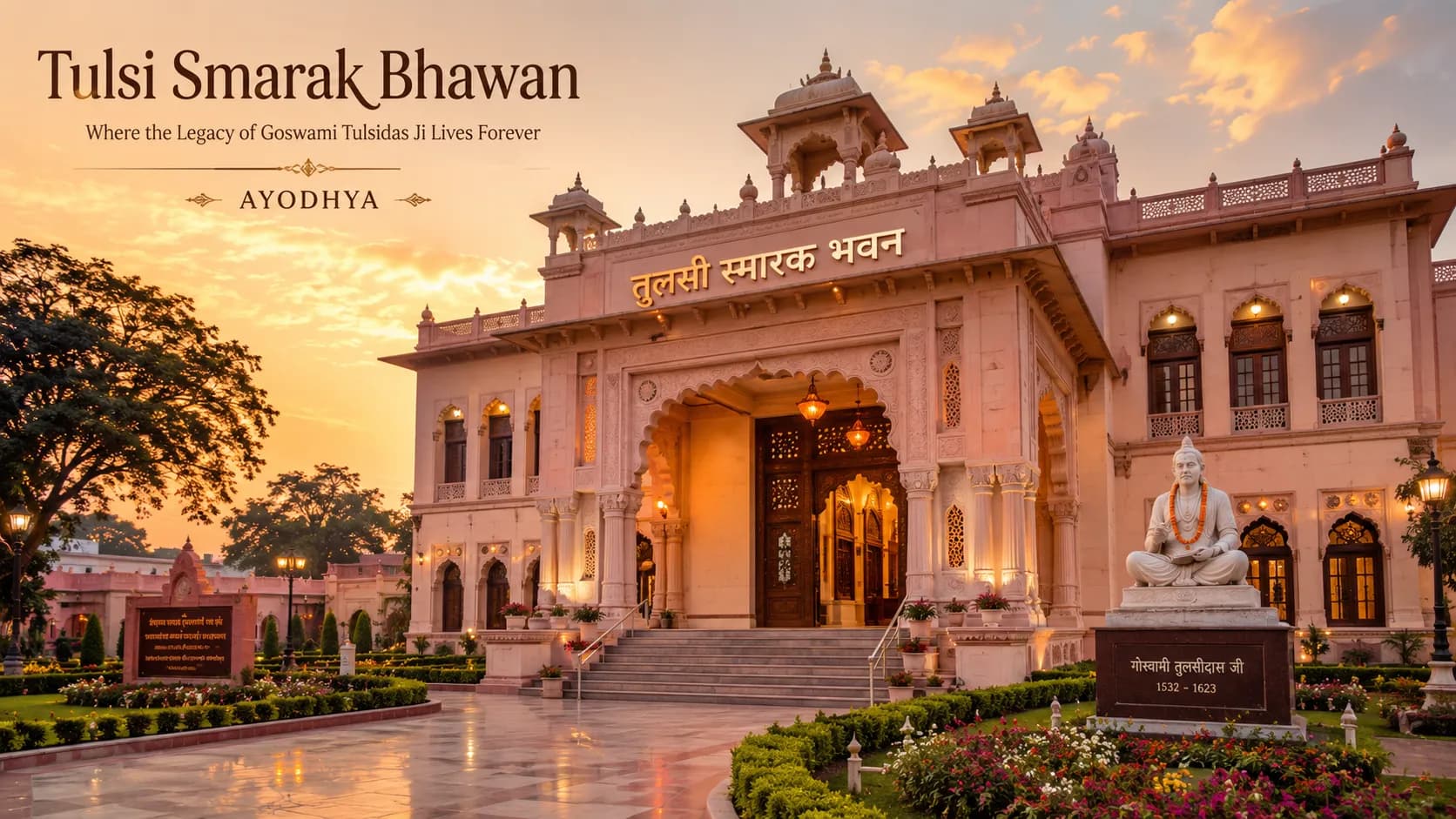
Ayodhya is the city of Ram, and no one did more to place the story of Ram in the hearts of the ordinary people of North India than Goswami Tulsidas, the great sixteenth-century poet-saint. And so it is fitting that Ayodhya honours him with this beautiful cultural memorial, the Tulsi Smarak Bhawan, built in 1969 on the initiative of the Governor of Uttar Pradesh, on a spot that tradition holds to be one of the places where Tulsidas himself composed his immortal Ramcharitmanas. In its main hall stands a large statue of Goswami Tulsidas, seated in meditation, and around it are galleries of manuscripts, paintings and sculptures depicting the scenes of the Ramayana and the life of the poet, along with modern audio-visual presentations that bring his story and his epic vividly to life. It is at once a memorial, a museum, a library and a living cultural centre, all devoted to Tulsidas and to the tale he told.
The daily Ramleela
The jewel of the Tulsi Smarak Bhawan, and the reason so many visitors come here in the evening, is its Ramleela. In a purpose-built cultural theatre within the Bhawan, a live enactment of the Ramleela, the dramatic telling of the whole story of Lord Ram, is staged every single evening of the year, from six to nine o'clock, and has been for many years. This is a rare and wonderful thing, for while the great Ramleelas of other places, such as the famous month-long Ramnagar Ramleela near Varanasi, are seasonal, this one plays daily, so that any evening you are in Ayodhya, you can watch the beloved story unfold before you, the exile and the forest, Sita's abduction, the war at Lanka, and the joyful return. It is a well-organised, moving performance, warmly recommended, and one of the loveliest ways to spend an evening in the holy city. See our guide to Ramnagar Fort for the great seasonal Ramnagar Ramleela.
The library, the research institute and the Ram Katha museum
Beyond the Ramleela, the Tulsi Smarak Bhawan is a serious and important centre of learning. It houses a great library, a treasure-store of the literature of Tulsidas, of the Ramcharitmanas and the Ramayana and of Ram devotion, of immense value to scholars and historians, and open to visitors. It is home to the Ayodhya Shodh Sansthan, the Ayodhya Research Institute, which studies and gathers the literary, cultural and spiritual heritage of Ayodhya and of the Ram tradition, including the many forms of the Ramleela across the world. And within the complex is the Ram Katha Sangrahalaya, a museum added in 1988 to collect, conserve and display the antiquities and art connected with the saga of Lord Ram. For anyone who wishes to go deeper into the story that makes Ayodhya holy, this is the place, a quiet, scholarly, devoted counterpoint to the great temples.
Goswami Tulsidas: the poet who brought Ram to every home
To understand why this memorial matters so much, one must know a little of the man it honours. Goswami Tulsidas, who lived across the sixteenth and seventeenth centuries, was a poet-saint of the Bhakti movement, so great a poet that he is called the Valmiki of Hindi, and he did something that changed the spiritual life of North India forever: he retold the ancient Sanskrit Ramayana of Valmiki in Awadhi, the language of the common people, as the Ramcharitmanas, so that the story of Ram, once the preserve of scholars, poured into every village, every home, every heart, sung and loved by all. He also gave the world the Hanuman Chalisa, recited daily by millions to this day. His devotion to Ram was total, and his life belonged to both of the holy cities: to Ayodhya, the birthplace of his Lord, and to Kashi, where he lived, wrote and died, where the ghat is named after him and where he founded the famous Sankat Mochan Hanuman temple. His birth anniversary, Tulsi Jayanti, on the seventh day of the bright half of Shravan, is celebrated here with joy.
For pilgrims who journey between Kashi and Ayodhya with us, Tulsidas is a golden thread joining the two cities. See our guides to the Tulsi Manas Mandir, Tulsi Ghat and Sankat Mochan Hanuman Temple.
The poet of both my cities, in my own words
By Rajeev Sharma, guide with Experience My India
Tulsidas is very dear to me, because he belongs to both of the cities I guide in: to Ayodhya, whose Lord he sang, and to my own Kashi, where he lived and wrote and died, where we have his ghat, and the Sankat Mochan temple he founded. So when I bring pilgrims to the Tulsi Smarak Bhawan in Ayodhya, I feel I am introducing them to an old family friend. I show them his statue, seated in meditation, and I tell them the great thing he did, that he took the story of Ram out of the Sanskrit of the scholars and gave it to all of us, in our own language, in the Ramcharitmanas, so that even a poor villager could sing of Ram. That is why we love him.
But the thing I most love to arrange here is the evening Ramleela. I tell my guests: come at six o'clock, and you will see the whole story of Ram acted out, right here, every single night. Families love it, children love it, and it is a beautiful, gentle end to a day of temples. I remind those who will also visit my Kashi that there we have the great Ramnagar Ramleela, a month long, and the Tulsi Manas temple with the Ramcharitmanas written on its walls, so the thread of Tulsidas runs through their whole pilgrimage. To sit and watch the Ramleela at Tulsidas's own memorial, in Ram's own city, is a lovely thing.
In more than forty years of guiding, this is the evening I most often arrange to close a happy day in Ayodhya.
; confirm any photography restrictions inside.]*
What to see and do
- Watch the daily Ramleela, the live enactment of the Ram story, every evening from 6 to 9 PM.
- See the meditative statue of Goswami Tulsidas and the galleries of Ramayana art and manuscripts.
- Explore the library and the Ram Katha museum of Ram antiquities.
- Learn of the Ayodhya Shodh Sansthan and the study of the Ramleela traditions.
- Enjoy the devotional programmes, bhajans, kirtan and discourses, and the peaceful gardens.
How to reach Tulsi Smarak Bhawan
The Bhawan is on the National Highway at Rajgang Crossing, in New Colony, Ayodhya, easily reached by road from the temples and the town.
| From | Distance | Notes |
|---|---|---|
| The core temples (Ram Mandir, Hanuman Garhi) | A short drive | By e-rickshaw, auto or taxi through the town. |
| The Saryu ghats | A short drive | Combine with the riverfront. |
| Ayodhya Dham Junction (railway) | A few km | By e-rickshaw, auto or taxi. |
| Maharishi Valmiki Airport, Ayodhya | About 10 to 12 km | The new airport; taxis and autos to the town. |
Because the Ramleela is in the evening, it fits perfectly at the end of a day of temples and the Saryu aarti.
Best time to visit and how to plan it
| When | Why |
|---|---|
| Evening, 6 to 9 PM | For the daily Ramleela, the highlight; a lovely close to the day. |
| Daytime (not Monday or the 2nd Sunday) | For the museum, the statue, the galleries and the library. |
| Tulsi Jayanti (Shravan) | The birth anniversary of Tulsidas, celebrated here with special joy. |
| After the Saryu aarti | Come from the riverfront to the evening Ramleela. |
- Pair the museum by day with the core temples, and the Ramleela in the evening.
- Allow an hour for the museum and library, and the full evening for the Ramleela.
For Ayodhya, or a combined Kashi and Ayodhya pilgrimage, planned end to end, see our tour packages.
Accessibility for elderly and mobility limited visitors
- The Bhawan is a modern building, largely at ground level, reachable by road, easier than the old-city temples.
- The Ramleela is a seated performance, comfortable for elderly guests; come a little early for a good seat.
- The museum, library and gardens are calm and unhurried.
- We arrange transport and plan a gentle visit and an evening Ramleela within your Ayodhya day.
Nearby sacred sites in Ayodhya
Tulsi Smarak Bhawan sits near the heart of Ayodhya, among the great Ram sites.
| Site | What it is | Internal link |
|---|---|---|
| Shri Ram Janmabhoomi Mandir | The grand temple of Lord Ram. | /temple/ayodhya/ram-janmabhoomi-mandir |
| Hanuman Garhi | The guardian temple of Hanuman, visited first. | /temple/ayodhya/hanuman-garhi |
| Kanak Bhavan | The Golden Palace of Ram and Sita. | /temple/ayodhya/kanak-bhavan |
| Tulsi Manas Mandir (Varanasi) | The temple in Kashi with the Ramcharitmanas on its walls. | /temple/varanasi/tulsi-manas-mandir |
| Tulsi Ghat (Varanasi) | The ghat in Kashi where Tulsidas lived and wrote. | /temple/varanasi/tulsi-ghat |
For the Ram Mandir darshan and its free Sugam booking, see our Ram Janmabhoomi Mandir guide.
Our guided visit and Ayodhya cultural evenings
We are a Varanasi and Ayodhya based operator, a unit of Experience My India, with more than forty years of guiding pilgrims across Kashi, Ayodhya, and Prayagraj, and we have our own local guide and pandit in Ayodhya. Entry is free, so what we arrange is a rich cultural visit: a guide who tells the story of Tulsidas and the Ramcharitmanas, a walk through the museum and library, and, above all, an evening at the daily Ramleela, woven into a full and well-planned day of Ayodhya with the temples and the Saryu aarti.
| Service | Includes | Price |
|---|---|---|
| Guided visit and evening Ramleela | The museum and library by day, and the evening Ramleela, with a guide. | Contact us for pricing |
| Ayodhya cultural day | Tulsi Smarak Bhawan with the core temples and the Saryu aarti. | Contact us for pricing |
| Tulsidas and Ramayana trail | The Tulsidas and Ramayana sites of Ayodhya, with a guide. | Contact us for pricing |
| Kashi and Ayodhya pilgrimage | Varanasi and Ayodhya, following the golden thread of Tulsidas. | Contact us for pricing |
Inclusions and exclusions are stated up front, with any taxes and conditions, and no charge appears later that was not named. Entry is free; our charge is only for guiding and services. See all our tour packages for the full range.
Experience My India is a travel operator, not the Bhawan administration. Entry is free; our charge is only for our guiding and services. Timings and the Ramleela schedule are set by the Bhawan and can change.