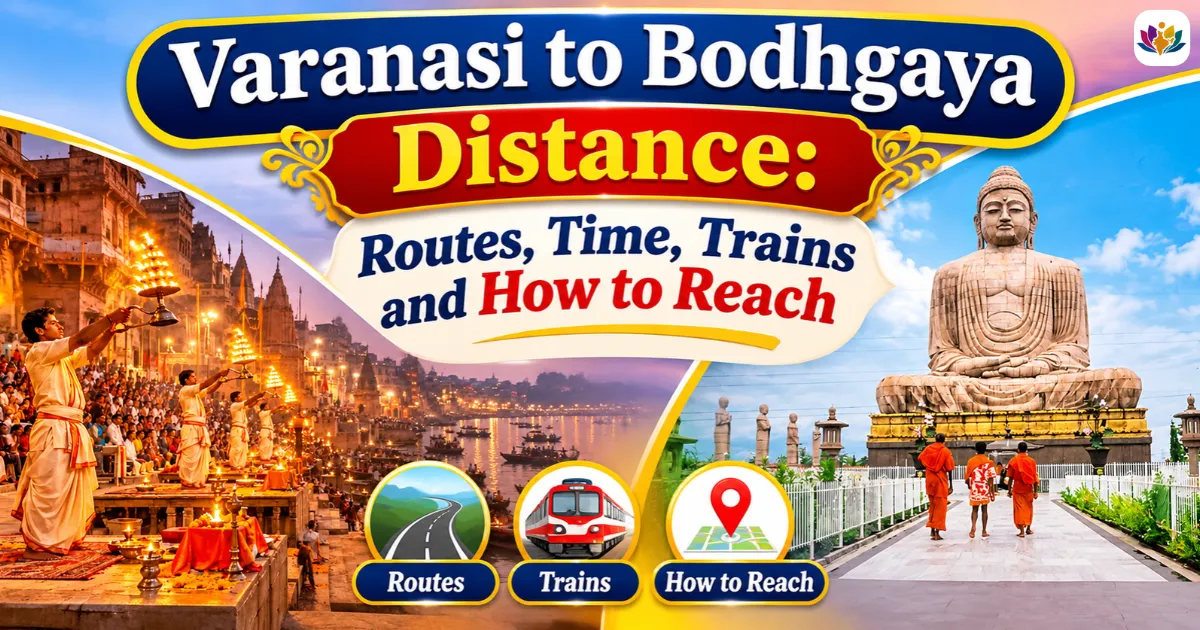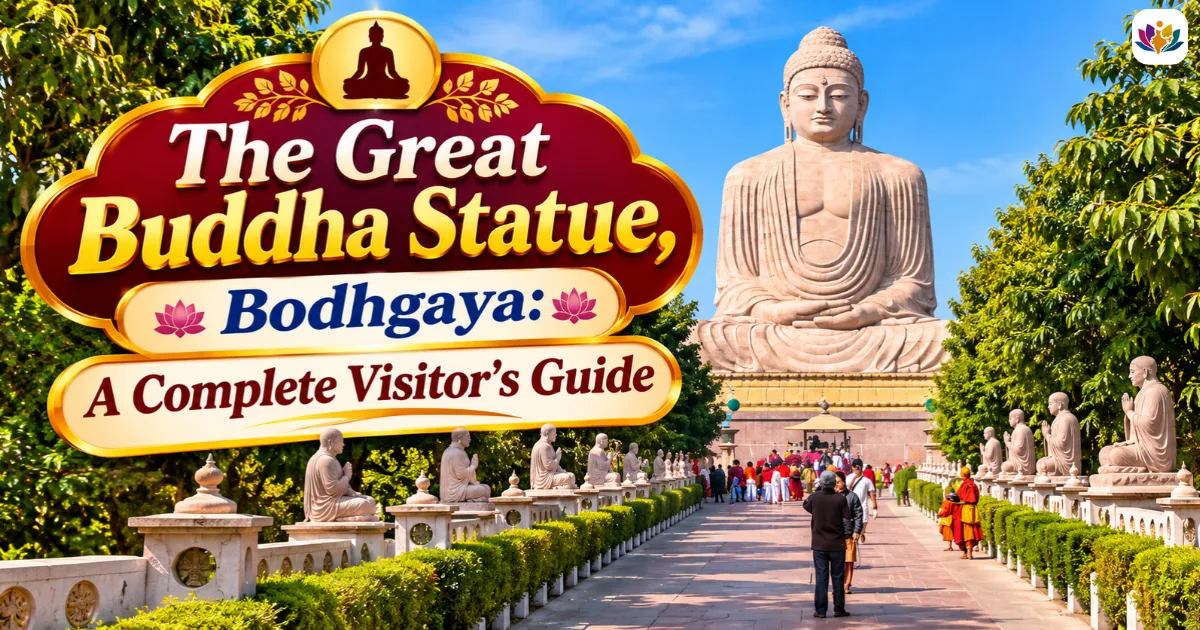
Rising 80 feet above a quiet garden in Bodhgaya, the Great Buddha Statue is one of India's most beloved Buddhist landmarks, a serene, meditating Buddha carved from sandstone and red granite. Consecrated by the 14th Dalai Lama in 1989, it stands a short walk from the Mahabodhi Temple, where the Buddha was enlightened. Having brought travellers here many times, let me give you the full guide to the Great Buddha Statue: its history, who built it, its remarkable design and everything you need to visit. Browse our Ayodhya Varanasi Tour Packages to plan the Buddhist trail with a local guide.
Great Buddha Statue: Key Takeaways
- What it is: an 80-foot (24 m) open-air statue of the Buddha seated in meditation on a lotus.
- Who built it: the Daijokyo Buddhist Temple of Nagoya, Japan; designed by architect V. Ganapati Sthapati.
- When: foundation laid 1982, consecrated by the 14th Dalai Lama on 18 November 1989.
- Where: on Temple Street, about 1.5 km from the Mahabodhi Temple.
- Visiting: entry free; usually open about 7 AM to 12 PM and 2 to 5:30 PM; cameras allowed, unlike the Mahabodhi Temple.
Timings and fees follow the statue's published information but can change; confirm the current details before your visit.
A Word From Your Guide
I am Rajeev Sharma, born in Varanasi and guiding pilgrims across Bodhgaya, Gaya, Kashi and the Buddhist trail for more than forty years. The Great Buddha Statue is a favourite stop, calm, green and unusually relaxed: here you may take photos freely, which the Mahabodhi Temple does not allow and the garden with its ten disciples is a lovely, gentle place to sit. It pairs naturally with the nearby Japanese and Thai monasteries. I speak Hindi, Telugu and Kannada, so South Indian families are at ease. Let me share the full story and the practical details.
History: Who Built the Great Buddha Statue
The Great Buddha Statue was commissioned by the Daijokyo Buddhist Temple of Nagoya, Japan, to spread peace and honour the site of the Buddha's enlightenment. The foundation stone was laid in 1982 and construction took seven years, with the statue consecrated on 18 November 1989 by the 14th Dalai Lama. It was designed by the renowned Indian temple architect V. Ganapati Sthapati and built by the combined labour of some 12,000 stonemasons, using chiselled Chunar sandstone and red granite that give it its warm, distinctive hue.
Architecture, Dimensions and Symbolism
The statue is as remarkable in its engineering as in its serenity. Here are the key facts:
| Feature | Detail |
| Total height | About 80 feet (24 m) |
| Width | Nearly 60 feet (18 m) |
| The Buddha figure | About 64 feet (20 m) tall |
| Lotus pedestal | About 5 to 6 feet (1.5 to 1.8 m) |
| Lower base | About 10 feet (3 m) |
| Posture | Padmasana (full lotus), hands in dhyana mudra |
| Materials | Chunar sandstone and red granite |
| Consecrated | 18 November 1989, by the 14th Dalai Lama |
The Buddha sits in padmasana, the full lotus position, with his hands resting in his lap in the dhyana mudra, the gesture of deep meditation and spiritual balance. Inside the hollow core, a spiral staircase rises to chest level and the interior walls hold some 16,300 small bronze Buddha images, though public access to the staircase is generally restricted. Along the garden path stand ten smaller stone sculptures, five on each side, representing the Buddha's ten principal disciples.
Visiting the Great Buddha Statue
- Timings: usually open daily about 7:00 AM to 12:00 PM and 2:00 PM to 5:30 PM, closing for roughly two hours in the afternoon.
- Entry fee: free for all Indian and international visitors.
- Photography: allowed throughout the grounds, cameras and phones both, unlike the Mahabodhi Temple where they are banned.
- Footwear and dress: remove shoes before the inner courtyard; socks help on hot afternoon tiles. Dress modestly, covering shoulders and knees.
- Accessibility: flat, paved pathways make the main viewing courtyard friendly for wheelchairs.
Timings and the afternoon closure can change; the early morning slot after 7 AM is best for quiet and cool stone underfoot.
How to Reach the Great Buddha Statue
- From the Mahabodhi Temple: about 1.5 km, at the end of Temple Street; an easy walk or a short e-rickshaw ride.
- By air: Gaya International Airport is about 12 km away, roughly 20 to 25 minutes by taxi or auto.
- By rail: Gaya Junction, about 16 to 20 km, is the nearest major station, 30 to 40 minutes by cab or shared auto.
- Local transport: e-rickshaws and cycle-rickshaws run frequently between the Mahabodhi Temple and Great Buddha Road; confirm the fare before boarding.
Many pilgrims reach Bodhgaya through the region's great cities; see our guides from Lucknow to Gaya and from Lucknow to Varanasi, the usual gateways to the Buddhist trail.
Nearby Attractions to Combine
The Great Buddha Statue sits among the international monasteries, so you can see several within a short walk:
- Daijokyo Buddhist Temple: right beside the statue, the Japanese temple that built it, with a serene main hall.
- Indosan Nipponji Japanese Temple: a short walk away, in traditional wooden Japanese style, with murals of the Buddha's life.
- Wat Thai Buddhagaya: an ornate Thai monastery with golden tiered roofs and a large bronze Buddha.
- Mahabodhi Temple: the UNESCO site of the enlightenment and the Bodhi Tree, about 1.5 km away.
These sites are kept here as a plain guide, since they sit outside our main Kashi circuit; a short walk or an e-rickshaw links them.
Best Time to Visit
October to March, the cool season, is the best time to visit the Great Buddha Statue, pleasant for the open garden and coinciding with the great winter monastic chanting festivals. Buddha Purnima in spring is the holiest festival of all. Avoid the fierce Bihar summer. If you are pairing with Varanasi, our guide to the best time to visit Varanasi follows the same seasons.
Extend to the Buddhist Trail at Sarnath
Bodhgaya is where the Buddha was enlightened; Sarnath, near Varanasi, is where he gave his first sermon, so the two belong on one trail. If you are adding Kashi, keep half a day for the Buddhist sites there:
- Mulagandha Kuti Vihar - the temple with its frescoes of the Buddha's life.
- Sarnath Archaeological Museum - home to the Ashokan lion capital, India's emblem.
- Chaukhandi Stupa - the mound where the Buddha met his first disciples.
- Vishwa Shanti Stupa, Sarnath - the white peace pagoda at the deer park.
For the short hop near Kashi, see our guide to the drive from Varanasi to Sarnath.
Pair Bodhgaya With Kashi
Most pilgrims reach Bodhgaya by way of Kashi, which shares the railway line and holds the Ganga darshan. While you are there, keep time for the Kashi Vishwanath Temple, the evening Ganga Aarti at Dashashwamedh, a dawn boat ride on the Ganga and Manikarnika Ghat. Those with more days travel on from Varanasi to Ayodhya for Ram Lalla's darshan.
The Honest Bit
Let me be straight with you. The Great Buddha Statue is a modern monument, barely forty years old, not an ancient relic and some pilgrims expect something older. Take it for what it is: a serene, generous gift from Japan to Bodhgaya and one of the few sites here where you may photograph freely. It closes for about two hours each afternoon, so time your visit for the morning or the later afternoon. The interior staircase is usually shut, so do not count on going inside. Visit early, pair it with the Daijokyo and Thai monasteries next door and it is a calm, uplifting hour.
Why Experience My India Is the Right Choice
I am Rajeev Sharma, born in Varanasi and guiding pilgrims for more than forty years across Bodhgaya, Gaya, Kashi and Ayodhya. For Bodhgaya we arrange a car and a guide for the Great Buddha Statue, the Mahabodhi Temple and the monasteries, time the visits around the afternoon closures and add the wider Buddhist trail to Sarnath and Kashi if you wish. I speak Hindi, Telugu and Kannada, so South Indian families are at ease. With our Ayodhya Varanasi Tours team, your Bodhgaya visit is taken care of.
| Tip from Rajeev Sharma: Come to the Great Buddha Statue in the morning slot, soon after it opens, when the garden is cool and quiet and the light on the sandstone is soft. Take your photos freely here, since you cannot at the Mahabodhi Temple and walk the path of the ten disciples slowly. Step next door to the Daijokyo temple that built the statue and the Thai and Japanese monasteries close by. Mind the two-hour afternoon closure, keep socks for the hot tiles and this is one of the gentlest, happiest hours in Bodhgaya. |
Related Packages
- Kashi Buddha Trail, 6 days - Kashi, Sarnath and Bodhgaya together.
- Kashi Gaya Ayodhya tour package - the great tirthas in one journey.
- Gaya pind daan package - add the shraddha at nearby Gaya.
- Gaya pind daan moksha package - the fuller shraddha and moksha rite over more days.
- Complete circuit: Ayodhya, Prayagraj, Kashi & Bodhgaya, 10 days - the grand pilgrimage, Bodhgaya included.
Plan Your Bodhgaya Trip
Tell me your dates and your group size and I will arrange a car and a guide for the Great Buddha Statue, the Mahabodhi Temple and the monasteries and the wider Buddhist trail if you wish. Browse our Buddhist circuit package or call and WhatsApp +91 7302265809 and we will plan it together.
| Book Your Ayodhya - Varanasi Trip Today |
| 📞 +91-7302265809 |
| 💬 WhatsApp: +91-7302265809 |
| We Reply in 30 Minutes |
| Packages start from ₹1,999/ person | Rated 4.9★ |
| Explore all: Ayodhya Varanasi Tours |
| Jai Shri Hari 🙏 |