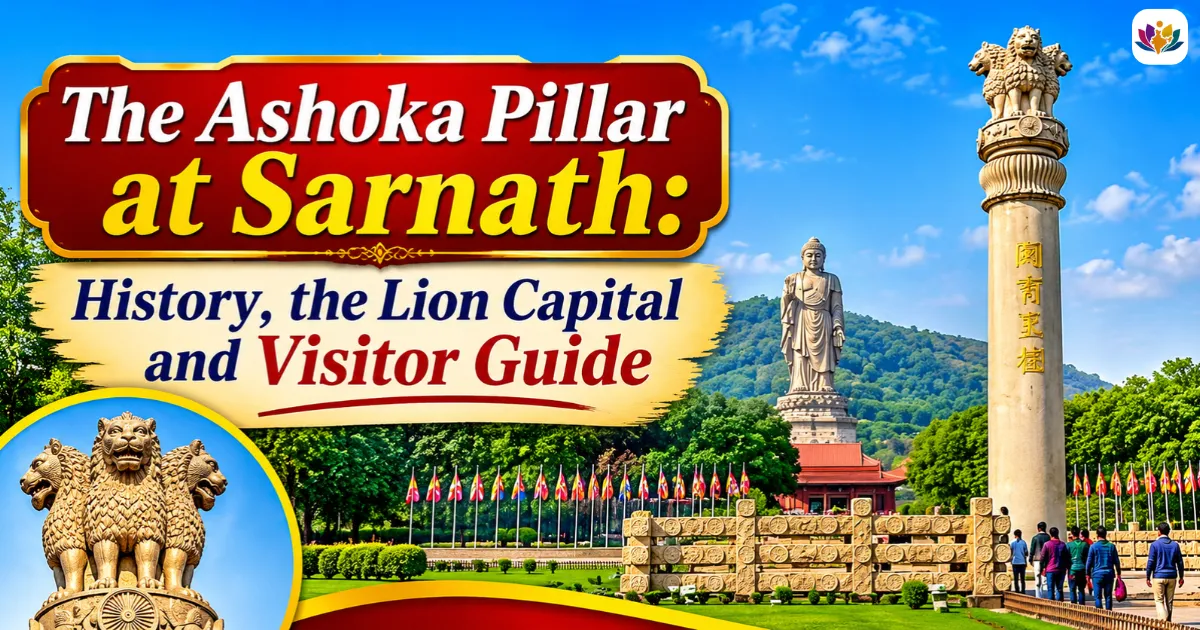
The Ashoka Pillar at Sarnath, just 10 km from Varanasi, is one of India's most important monuments: a third-century BCE sandstone column raised by Emperor Ashoka, crowned by the four-lion capital that became the National Emblem of India. The pillar's base still stands amid the Sarnath ruins, while the famous Lion Capital is preserved in the museum next door. Having guided visitors through Sarnath for years, let me give you the full story of the Ashoka Pillar, its symbolism and everything you need to visit. Browse our Ayodhya Varanasi Tour Packages to plan the trip with a local guide.
Ashoka Pillar Sarnath: Key Takeaways
- Who and when: raised by Emperor Ashoka around 250 BCE, at the Deer Park where the Buddha preached his first sermon.
- The Lion Capital: four Asiatic lions back to back, adopted as India's National Emblem on 26 January 1950.
- Where it is now: the Lion Capital is in the Sarnath Archaeological Museum; the pillar stump stands among the ruins.
- The material: a single block of Chunar sandstone, famous for its mirror-like Mauryan polish.
- Visiting: the ruins open sunrise to sunset; the museum 9 AM to 5 PM, closed on Fridays.
Timings and fees follow current information but can change; confirm before visiting and avoid Fridays if the Lion Capital is a priority.
A Word From Your Guide
I am Rajeev Sharma, born in Varanasi and guiding visitors across Sarnath, Kashi and the Buddhist trail for more than forty years. The Ashoka Pillar moves me every time, not only for its 2,300-year-old mirror polish, but because the lions that crown it look out from every Indian coin and passport. Most visitors miss that the pillar and its capital are now in two places, the stump in the ruins and the capital in the museum, so let me set it all out clearly. I speak Hindi, Telugu and Kannada, so South Indian families are at ease.
History and Significance of the Ashoka Pillar
- Commissioned by Ashoka: the Mauryan emperor raised it around 250 BCE as part of his spread of the Buddha's teaching.
- Why here: it marks Isipathana, the Deer Park, where the Buddha delivered his first sermon, the Dhammacakkappavattana Sutta, after his enlightenment.
- The craftsmanship: carved from a single block of buff Chunar sandstone, with the mirror-like Mauryan polish that still shines after two millennia.
- Rediscovery: excavated in 1905 by the German archaeologist F.O. Oertel, who found the intact Lion Capital and the broken shaft.
Anatomy and Symbolism of the Pillar
The pillar is rich in meaning, from its edict to the emblem it became. Here is what each part signifies:
| Part | What it is | Meaning |
| The shaft | Originally about 15 m (50 ft) tall | Now a stump in the ruins, under glass |
| The inscription | An Ashokan Schism Edict in Brahmi script | Warns monks against dividing the Sangha |
| Four lions | Asiatic lions, back to back, facing the four directions | Power, courage, pride, confidence; India's emblem |
| The abacus | Elephant, bull, horse and lion in relief | The four great events of the Buddha's life |
| The Dharma Chakra | 24-spoked wheels between the animals | The cosmic law; at the centre of the national flag |
| Inverted lotus | A bell-shaped lotus beneath the abacus | Purity and awakening |
The original Dharma Chakra wheel that once crowned the lions is broken and preserved in fragments in the Sarnath Museum.
The Lion Capital: India's National Emblem
The four-lion Lion Capital is the most famous part of the pillar and the most important object in Sarnath. Adopted as the State Emblem of India on 26 January 1950, it appears on currency, passports and government seals across the country. The abacus below the lions carries four animals moving clockwise, an elephant for the Buddha's conception, a bull for his zodiac sign, a horse for his departure from palace life and a lion for his enlightenment, separated by the 24-spoked Dharma Chakra that sits at the heart of the national flag. The original capital is displayed in the Sarnath Archaeological Museum, right across from the ruins, alongside exquisite Gupta-era Buddha statues.
Timings and Entry Fees
Sarnath has two tickets, one for the archaeological site and ruins, one for the museum. The details below are indicative; confirm them when you visit.
| Place | Timings | Entry (indicative) |
| Archaeological site & ruins | Sunrise to sunset (about 6 AM to 5:30 PM) | Indians about 25 to 30 rupees; foreign nationals 300 to 500 |
| Sarnath Archaeological Museum | 9:00 AM to 5:00 PM, closed Fridays | About 5 rupees; children under 15 free |
Children under 15 enter the site free. Digital or UPI payment is widely accepted and sometimes a little cheaper than cash. Fees change, so treat these as a guide.
Must-See Attractions Around the Pillar
The Ashoka Pillar sits within a compact complex of extraordinary Buddhist monuments. Keep time for:
- Sarnath Archaeological Museum - home to the original Lion Capital and Gupta-era Buddhas (closed Fridays).
- Dhamekh Stupa - the massive 43 m stupa marking the spot of the first sermon.
- Mulagandha Kuti Vihar - the modern temple with its frescoes of the Buddha's life and the Deer Park.
- Chaukhandi Stupa - about 800 m before the main site, where the Buddha met his first five disciples.
- Vishwa Shanti Stupa - the white peace pagoda, near the Thai, Tibetan and Japanese temples.
How to Reach the Ashoka Pillar, Sarnath
- By road from Varanasi: about 10 km from Varanasi Cantt station and 13 km from the ghats, 30 to 45 minutes by auto, e-rickshaw or cab.
- By air: Lal Bahadur Shastri International Airport, Varanasi, is about 25 km away, a 45 to 60 minute taxi ride.
- By train: Sarnath has a small station, but Varanasi Junction offers far better connectivity across India.
For the short hop, see our guide to the drive from Varanasi to Sarnath or take our 1-day Varanasi city and Sarnath tour.
Pair Sarnath With Kashi
Sarnath is only 10 km from Varanasi, so pilgrims almost always pair the two. While you are in Kashi, keep time for the Kashi Vishwanath Temple, the evening Ganga Aarti at Dashashwamedh, a dawn boat ride on the Ganga and Manikarnika Ghat. Many reach the city from Lucknow to Varanasi and travel on from Varanasi to Ayodhya or from Varanasi to Chitrakoot.
Best Time to Visit
October to March, with pleasant daytime temperatures, is the best season for walking the open-air ruins. Buddha Purnima in spring, the Buddha's birthday, is specially kept at Sarnath and the city glows at Dev Deepawali. Avoid the fierce summer and see our guide to the best time to visit Varanasi for your dates.
Essential Visitor Tips
- Avoid Fridays for the museum: the Lion Capital is inside the Sarnath Museum, which is closed on Fridays, so plan around that.
- Hire an ASI guide: an approved guide at the entrance helps decode the carvings on the stupas and the Brahmi inscription on the pillar.
- Footwear and etiquette: keep silence near meditating monks and remove shoes before the Mulagandha Kuti Vihar and the international shrines.
- Dress for walking: the complex has grassy lawns and stone paths, so wear comfortable slip-on shoes and carry water and sunscreen.
The Honest Bit
Let me be straight with you. The thing most visitors get wrong is expecting to see the famous Lion Capital standing on a tall pillar in the ruins; it is not. The pillar itself is now a protected stump under glass and the Lion Capital, the National Emblem, is in the museum across the road, which is closed on Fridays. So if the emblem is your reason for coming, do not visit on a Friday. The ruins are open lawns with little shade, so come in the cool season and the morning, carry water and take an ASI guide to bring the Brahmi edict and the carvings to life. Seen properly, Sarnath is one of the most rewarding half-days near Varanasi.
Why Experience My India Is the Right Choice
I am Rajeev Sharma, born in Varanasi and guiding visitors for more than forty years across Sarnath, Kashi, Bodhgaya and Ayodhya. For Sarnath we time your visit to miss the Friday museum closure, arrange an ASI-approved guide for the pillar, the edict and the stupas and pair it neatly with a Kashi darshan and the Ganga. I speak Hindi, Telugu and Kannada, so South Indian families are at ease. With our Ayodhya Varanasi Tours team, the Ashoka Pillar and the first sermon come alive.
| Tip from Rajeev Sharma: Reach Sarnath in the morning, start at the Chaukhandi Stupa, then the main ruins and the pillar stump and cross to the museum to stand before the real Lion Capital, remembering it closes on Fridays. Take an ASI guide to read the Brahmi edict and the abacus animals, keep silence near the meditating monks and end at the Mulagandha Kuti Vihar and the Deer Park. Carry water and wear slip-on shoes for the lawns. Paired with a Kashi evening aarti, it makes a perfect day. |
Related Packages
- Varanasi, Ayodhya and Prayagraj tour, 4 days - Kashi, Sarnath and the wider circuit together.
- Buddhist circuit package - Sarnath to Bodhgaya, the path of the Buddha.
- Kashi Buddha Trail, 6 days - Kashi, Sarnath and Bodhgaya in one journey.
Plan Your Sarnath and Kashi Trip
Tell me your dates and your group size and I will time your Sarnath visit around the museum, arrange an ASI guide and pair it with a Kashi darshan and the Ganga. Browse our Varanasi tour packages or call and WhatsApp +91 7302265809 and we will plan it together.
| Book Your Ayodhya - Varanasi Trip Today |
| 📞 +91-7302265809 |
| 💬 WhatsApp: +91-7302265809 |
| We Reply in 30 Minutes |
| Packages start from ₹1,999/ person | Rated 4.9★ |
| Explore all: Ayodhya Varanasi Tours |
| Jai Shri Hari 🙏 |