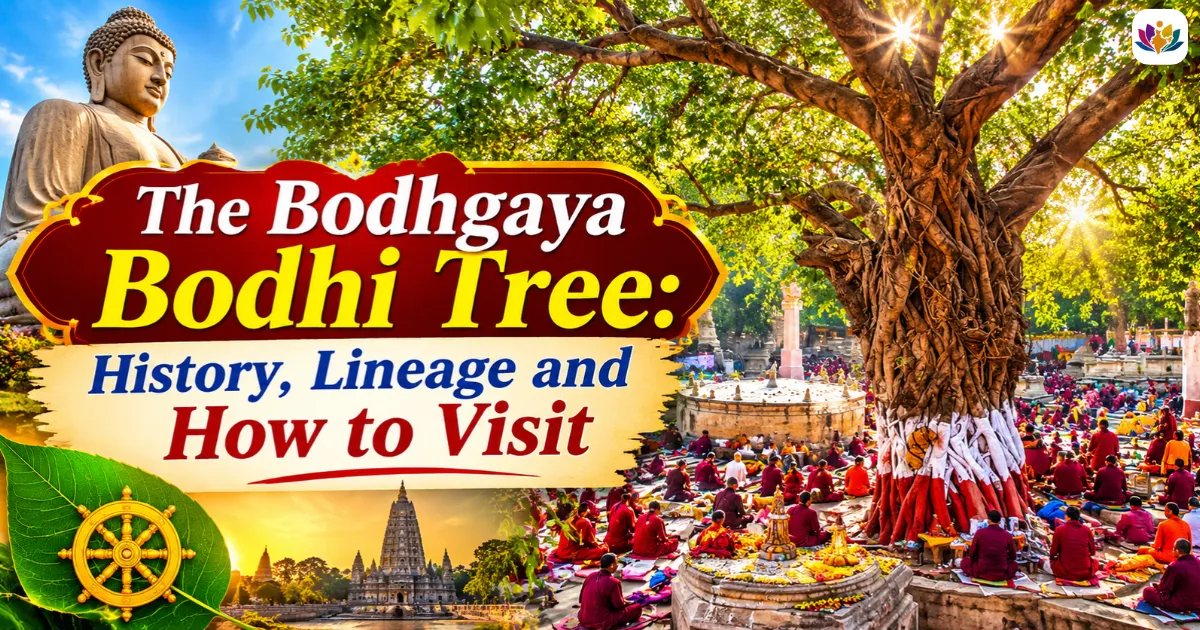
The Bodhi Tree in Bodhgaya is the most sacred tree in the world, the sacred fig (Ficus religiosa) under which Prince Siddhartha became the Buddha around the fifth century BCE. It stands just west of the Mahabodhi Temple, with Ashoka's Vajrasana at its foot marking the exact seat of enlightenment. The tree you see today is the fifth in an unbroken lineage traced back 2,500 years to the original. Having sat beneath it with many pilgrims, let me share the full story of the Bodhgaya Bodhi Tree: its history, its remarkable lineage and everything you need to visit. Browse our Ayodhya Varanasi Tour Packages to plan the Buddhist trail with a local guide.
Bodhgaya Bodhi Tree: Key Takeaways
- What it is: the sacred fig (Ficus religiosa) under which the Buddha was enlightened, west of the Mahabodhi Temple.
- Its age: the current tree is roughly 145 to 150 years old; its lineage runs back over 2,500 years.
- Which generation: the fifth in the line, planted in 1881 from a sapling of the Sri Lankan Anuradhapura tree.
- At its foot: the Vajrasana, the diamond throne placed by Ashoka, marking the exact seat of enlightenment.
- Visiting: open about 5:00 AM to 9:00 PM, entry free; phones banned and plucking leaves is strictly forbidden.
Timings and fees follow the temple committee's published information but can change; confirm the current details before visiting.
A Word From Your Guide
I am Rajeev Sharma, born in Varanasi and guiding pilgrims across Bodhgaya, Sarnath, Kashi and the Buddhist trail for more than forty years. Of all the holy places I know, nothing compares to a dawn beneath the Bodhi Tree, the prayer flags, the quiet chanting of monks from many nations, the fallen heart-shaped leaves. The tree is the living heart of Bodhgaya and understanding its long lineage makes the visit all the more moving. Let me share the story and the practical details. I speak Hindi, Telugu and Kannada, so South Indian families are at ease.
The History and Lineage of the Bodhi Tree
The Bodhi Tree's story is one of destruction and renewal across 2,500 years, with the sacred line preserved through cuttings carried far and wide:
- The original tree: Siddhartha Gautama meditated beneath a peepal on the banks of the Niranjana and attained Nirvana on the full moon of Vaisakha.
- The Sri Lankan lineage: in the 3rd century BCE, Ashoka's daughter Sanghamitta carried a sapling to Anuradhapura, planted in 288 BCE as the Jaya Sri Maha Bodhi, the oldest human-planted tree in the world.
- Repeated destruction: the Bodh Gaya tree was damaged over the centuries, by tradition through Ashoka's queen Tissarakkha, King Pushyamitra Shunga and King Shashanka around 600 CE.
- The current tree, 1881: the fourth-generation tree fell in a storm in the 1870s and the archaeologist Sir Alexander Cunningham planted a sapling of the Anuradhapura lineage in 1881.
So the living tree is young, about 145 to 150 years, but it is grown from the unbroken line of the original, which is why pilgrims honour it as the very tree of the enlightenment.
How Old Is the Bodhgaya Bodhi Tree?
The tree standing today is roughly 145 to 150 years old, having been planted in 1881. But its genetic lineage spans more than 2,500 years, traced through historical cuttings back to the original tree of the enlightenment and preserved above all through the Sri Lankan Jaya Sri Maha Bodhi at Anuradhapura. In this sense the Bodhi Tree is both one of the youngest and one of the oldest sacred trees on earth.
Sacred Landmarks Around the Bodhi Tree
The Bodhi Tree sits at the heart of the 4.86-hectare Mahabodhi complex, ringed by the monuments of the Buddha's seven weeks after enlightenment:
| Landmark | What it marks | Where |
| Vajrasana (Diamond Throne) | Ashoka's slab marking the exact seat of enlightenment | At the foot of the tree |
| Mahabodhi Mahavihara | The 50 to 55 m Gupta-era brick temple and gilded Buddha | Beside the tree |
| Animesh Lochan Chaitya | Week 2: gazing unblinking at the tree in gratitude | Northeast of the tree |
| Chankramana (Jewel Walk) | Week 3: walking meditation, carved with lotuses | North of the temple |
| Muchalinda Lake | Week 6: the serpent king sheltered the Buddha | To the south |
The seven-week landmarks are best seen slowly and clockwise, beginning and ending at the Bodhi Tree itself.
Timings, Entry Fee and Daily Rituals
The complex is managed by the Bodhgaya Temple Management Committee and welcomes visitors of all faiths daily. The details below follow its published information; treat fees and timings as indicative and confirm them when you visit.
| Detail | Information |
| Opening hours | About 5:00 AM to 9:00 PM daily |
| General entry | Free for all Indian and international visitors |
| Camera / video | About 100 rupees still, 300 rupees video (BTMC counter) |
| Meditation Park | About 20 rupees per person |
| Morning chanting | About 5:30 to 6:00 AM, Sutta chanting and meditation |
| Kheer offering | About 10:00 AM, the daily offering of rice pudding |
| Evening chanting | About 6:00 to 7:00 PM, Mahayana then Pali |
Fees and timings are set by the temple committee and change from time to time; the figures above are a guide, not a guarantee.
Rules and Etiquette at the Bodhi Tree
- Protect the tree: plucking leaves, breaking twigs or touching the main trunk is strictly forbidden; staff distribute naturally fallen leaves to pilgrims.
- No phones or electronics: mobile phones, smartwatches and tablets are banned inside; cloakrooms and lockers are outside the main entrance.
- Footwear and dress: remove shoes and socks at the stand, dress modestly covering shoulders and knees and avoid clothing or tattoos showing images of the Buddha.
- Bag restrictions: leather items, large backpacks, food, drinks and smoking materials are not allowed inside.
These rules protect a 2,500-year-old living heritage; follow them with care and simply sit and be present beneath the tree.
Best Time to Visit the Bodhi Tree
October to March, when days are a pleasant 15 to 25 degrees, is the best season and it brings the great prayer festivals, the Kagyu Monlam Chenmo in December and Buddha Purnima in May, when thousands of monks gather. Arrive at 5:00 AM for the tranquil sunrise meditation or after 5:30 PM when the tree and temple are illuminated. Avoid the fierce Bihar summer. If pairing with Varanasi, see our guide to the best time to visit Varanasi.
How to Reach the Bodhi Tree
- By air: Gaya International Airport (GAY) is about 10 to 12 km away, a 20-minute taxi or auto ride, with flights from Delhi and Kolkata and seasonal international ones.
- By train: Gaya Junction (GAYA) is about 16 to 17 km north, connected to major cities by trains like the Mahabodhi Express and Rajdhani.
- Within Bodhgaya: the Bodhi Tree is inside the Mahabodhi complex in the heart of town, an easy walk or e-rickshaw from most hotels.
Many pilgrims reach Bodhgaya through the region's great cities; see our guides from Lucknow to Gaya and from Lucknow to Varanasi, the usual gateways to the Buddhist trail.
Extend to the Buddhist Trail at Sarnath
The Bodhi Tree marks the enlightenment; Sarnath, near Varanasi, is where the Buddha gave his first sermon, so the two belong on one trail. If you are adding Kashi, keep half a day for the Buddhist sites there:
- Mulagandha Kuti Vihar - the temple with its frescoes of the Buddha's life.
- Sarnath Archaeological Museum - home to the Ashokan lion capital, India's emblem.
- Chaukhandi Stupa - the mound where the Buddha met his first disciples.
- Vishwa Shanti Stupa, Sarnath - the white peace pagoda at the deer park.
For the short hop near Kashi, see our guide to the drive from Varanasi to Sarnath.
Pair Bodhgaya With Kashi
Most pilgrims reach Bodhgaya by way of Kashi, which shares the railway line and holds the Ganga darshan. While you are there, keep time for the Kashi Vishwanath Temple, the evening Ganga Aarti at Dashashwamedh, a dawn boat ride on the Ganga and Manikarnika Ghat. Those with more days travel on from Varanasi to Ayodhya for Ram Lalla's darshan.
The Honest Bit
Let me be straight with you. The living Bodhi Tree is young, about 145 years, not the literal tree of 2,500 years ago and some pilgrims are surprised by this. Take it for what it truly is: an unbroken descendant of the original, grown from the sacred Sri Lankan line and no less holy for it. Remember too that this is a strict, protected UNESCO site: phones are banned, you cannot pluck a leaf and the preservation rules are firmly enforced to guard a 2,500-year heritage. Come at dawn, leave your phone behind, sit quietly and accept a fallen leaf from the staff rather than reaching for one. It is one of the most peaceful hours on earth.
Why Experience My India Is the Right Choice
I am Rajeev Sharma, born in Varanasi and guiding pilgrims for more than forty years across Bodhgaya, Sarnath, Kashi and Ayodhya. For the Bodhi Tree and the Mahabodhi complex we arrange a calm, early darshan, a guide for the seven sacred spots, a good stay near the temple and the wider Buddhist trail to Sarnath and Kashi if you wish. We handle the lockers, the tickets and the timings. I speak Hindi, Telugu and Kannada, so South Indian families are at ease. With our Ayodhya Varanasi Tours team, your time beneath the tree is unhurried.
| Tip from Rajeev Sharma: Reach the Bodhi Tree for the 5:30 am chanting, when the courtyard is cool and quiet and the first light filters through the leaves. Leave your phone at the hotel so you are not turned back at the gate and carry only a little cash for the lockers and camera ticket. Sit a while at the Vajrasana, walk the seven sacred spots slowly and clockwise and if a leaf falls near you, let the staff hand it to you rather than reaching up. Stay for the kheer offering at ten. A dawn beneath the tree stays with you for life. |
Related Packages
- Kashi Buddha Trail, 6 days - Kashi, Sarnath and Bodhgaya together.
- Kashi Gaya Ayodhya tour package - the great tirthas in one journey.
- Gaya pind daan package - add the shraddha at nearby Gaya.
- Gaya pind daan moksha package - the fuller shraddha and moksha rite over more days.
- Complete circuit: Ayodhya, Prayagraj, Kashi & Bodhgaya, 10 days - the grand pilgrimage, Bodhgaya included.
Plan Your Bodhgaya Pilgrimage
Tell me your dates and your group size and I will arrange a calm darshan at the Bodhi Tree and the Mahabodhi Temple, a guide for the seven sacred spots, a good stay and the Buddhist trail to Sarnath and Kashi if you wish. Browse our Buddhist circuit package or call and WhatsApp +91 7302265809 and we will plan it together.
| Book Your Ayodhya - Varanasi Trip Today |
| 📞 +91-7302265809 |
| 💬 WhatsApp: +91-7302265809 |
| We Reply in 30 Minutes |
| Packages start from ₹1,999/ person | Rated 4.9★ |
| Explore all: Ayodhya Varanasi Tours |
| Jai Shri Hari 🙏 |