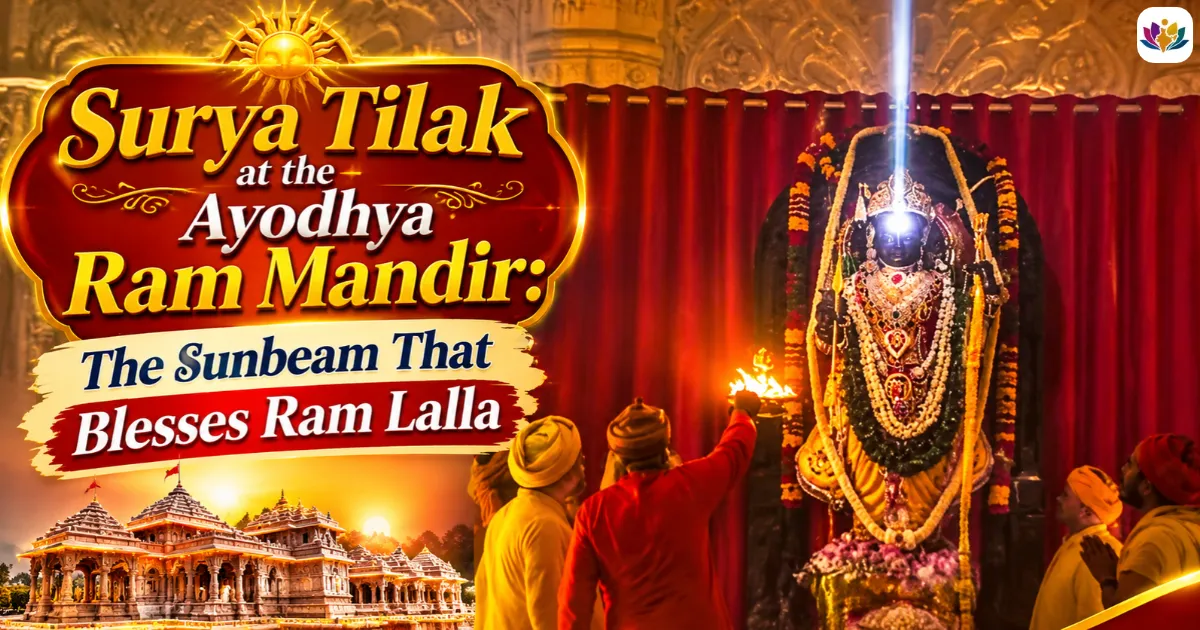
Every year at noon on Ram Navami, something extraordinary happens inside the Ayodhya Ram Mandir: a beam of pure sunlight travels down through the temple and lands as a glowing circle on the forehead of Ram Lalla, the Surya Tilak. It is not a trick of faith alone but a marvel of engineering, sunlight guided by mirrors and lenses so that the Sun himself anoints the newborn Ram. Having guided pilgrims through Ayodhya, let me explain exactly what the Surya Tilak is, when it happens, the science behind it, and how you can witness it. Browse our Ayodhya Varanasi Tour Packages to plan the trip with a local guide.
Surya Tilak at Ayodhya Ram Mandir: Key Takeaways
- What it is: a beam of sunlight that lights a circular tilak on Ram Lalla's forehead.
- When: at solar noon (about 12:00) on Ram Navami, Lord Ram's birth anniversary.
- How long: the beam appears for 3 to 4 minutes, brightest for about 2 to 3 minutes.
- The science: a periscope of mirrors and lenses, no electricity, designed by CSIR-CBRI and IIA.
- Seeing it: the ceremony draws huge crowds; it is also broadcast live, and it needs clear sky.
A Word From Your Guide
I am Rajeev Sharma, guiding pilgrims across Ayodhya and Kashi for more than forty years. The Surya Tilak moves people like little else I have seen, the whole sanctum falls silent as the light creeps onto Ram Lalla's brow. But I tell my guests the truth too: Ram Navami is the single most crowded day in Ayodhya, the beam lasts only minutes and depends on a clear sky, and most pilgrims watch it on the big screens rather than from inside the sanctum. Plan well and keep your heart open, and it is unforgettable. I speak Hindi, Telugu and Kannada, so South Indian families are at ease.
What Is the Surya Tilak?
The Surya Tilak is an opto-mechanical ritual, the word opto for light and mechanical for the gears and mirrors that steer it. At solar noon on Ram Navami, sunlight is captured high on the temple and guided down into the Garbhagriha, the sanctum, where it falls as a round mark of light, about 58 mm across, on the forehead of the Ram Lalla idol. The idol is carved from dark Shaligram stone, so the circle of gold light on the black surface is striking. It was first demonstrated on 17 April 2024, the first Ram Navami after the temple's consecration.
When Does the Surya Tilak Happen?
The Surya Tilak takes place once a year, at solar noon (around 12:00) on Ram Navami, the ninth day of the bright fortnight of Chaitra, which marks Lord Ram's birth and falls in March or April. Because the Hindu lunar calendar and the Gregorian solar calendar drift against each other, the Sun's exact position on Ram Navami repeats only on a 19-year cycle, the Metonic cycle. That is why the mechanism is adjusted a little every year. Always confirm the exact Ram Navami date and the ceremony timing for the year you plan to travel.
The Science and Engineering Behind It
The Surya Tilak works like a precision periscope, carrying sunlight from the top of the temple down into the sanctum entirely by optics, with no electricity, no motor and no sensor. Here is how, in plain terms:
- Who built it: it was designed by CSIR-CBRI (Central Building Research Institute), Roorkee, with optical design by the Indian Institute of Astrophysics (IIA), Bengaluru, and the brass and optical hardware made by Optica (Optics and Allied Engineering).
- The light path: mirrors and lenses catch the Sun on the third floor, bounce the beam vertically down through internal piping, then turn it horizontally into the sanctum onto Ram Lalla's forehead.
- The materials: high-grade brass and bronze for the piping and gears to resist corrosion, with high-reflectivity mirrors and anti-reflective lenses so almost no light is lost.
- The 19-gear system: a set of gears is adjusted by hand before each Ram Navami to track the Sun's annual shift over the 19-year cycle, keeping the beam on target without any power.
- Heat filtering: an infrared filter at the top blocks the Sun's heat, so the beam lights the idol brightly without warming or harming the sacred stone.
Key Facts at a Glance
| Detail | What to know |
| Occasion | Ram Navami, Lord Ram's birth anniversary (March or April) |
| Time | Around 12:00 noon (solar noon) |
| Duration | About 3 to 4 minutes; brightest for 2 to 3 minutes |
| Tilak size | A circular mark of roughly 58 mm |
| First shown | 17 April 2024 |
| Cycle | Solar position repeats on a 19-year (Metonic) cycle |
| Power used | None; sunlight guided by mirrors, lenses and gears |
Figures follow the project descriptions from CSIR-CBRI and IIA. Timing and the year's Ram Navami date should always be confirmed closer to your visit.
How to See the Surya Tilak
Witnessing the Surya Tilak from within the temple on Ram Navami is difficult, because it is the busiest day of the Ayodhya year and the sanctum holds only so many. Most pilgrims watch it on the large screens placed around the complex, and it is broadcast live on television and online, so you can see it clearly even from afar. If you hope to be near, reach the Ram Janmabhoomi Mandir very early and follow the day's arrangements closely; our Ram Mandir darshan guide explains the darshan route, the timings and the security, which tighten greatly on festival days.
Planning a Ram Navami Visit to Ayodhya
Ram Navami is extraordinary but intense, so plan ahead. Book your stay and travel months in advance, keep your schedule loose, and expect long queues and heavy security. The cool months either side of it are easier for the rest of the city; see our guide to the best time to visit Ayodhya. If the great festival crowds are not for you, the other grand Ayodhya occasion is Deepotsav on the eve of Diwali, when lakhs of lamps light the Saryu.
Pair It With the Rest of Ram's City
The Surya Tilak is a few minutes; give the rest of your visit to the soul of Ayodhya:
- Hanuman Garhi - the hilltop Hanuman fort, visited first by tradition.
- Kanak Bhavan - the golden palace temple of Ram and Sita.
- Saryu Aarti at Ram Ki Paidi - the grand evening fire ritual on the river.
- Guptar Ghat - a quiet riverside hour on the Saryu.
- Dashrath Mahal - the palace temple of Ram's father, alive with kirtan.
- Nageshwarnath Temple - the ancient Shiva temple of the old city.
The Honest Bit
Let me be straight with you. The Surya Tilak is genuine and beautiful, but set your expectations honestly. It lasts only three to four minutes and depends entirely on a clear midday sky, so if Ram Navami is overcast or rainy the beam may not appear. Almost no visitor sees it from inside the sanctum on the day itself; the screens and the live broadcast are how the vast majority watch, and that is perfectly fine. Above all, darshan at the Ram Mandir is free, and there is no official paid or VIP ticket for the Surya Tilak, so ignore anyone selling special access to it. Come for the devotion, not the perfect photograph, and the day rewards you.
Why Experience My India Is the Right Choice
I am Rajeev Sharma, guiding pilgrims for more than forty years across Ayodhya, Kashi and Prayagraj. For a Ram Navami visit we handle the hard parts, booking early, timing your darshan, finding a good screen vantage for the Surya Tilak, and arranging the rest of Ram's city around the crowds, with Kashi and Prayagraj added if you wish. I speak Hindi, Telugu and Kannada, so South Indian families are at ease. With our Ayodhya Varanasi Tours team, the day is smooth and full of meaning.
| Tip from Rajeev Sharma: If you want a real chance of a close view, treat Ram Navami as an all-day pilgrimage, not a quick stop: reach the complex before dawn, carry almost nothing for the security checks, and settle near a large screen with a clear line to the sanctum. Keep the afternoon for Hanuman Garhi and Kanak Bhavan once the noon rush eases, and the Saryu aarti for dusk. If the forecast is cloudy, do not despair, watch the live broadcast and give your day to darshan and the ghats instead. |
Plan Your Ram Navami and Surya Tilak Trip
Tell me your dates and your group size, and I will book early, plan your darshan and a good Surya Tilak vantage, and build the rest of Ayodhya around the crowds. Browse our Ayodhya tour packages or our Ram Navami Ayodhya package, or call and WhatsApp +91 7302265809, and we will plan it together.
Related Packages
- Ayodhya Ram Mandir tour package - focused on the Ram Lalla darshan and the main shrines.
- 3-day Ayodhya tour package - an unhurried stay covering the temples and the Saryu.
Read more before you go: things to do in Ayodhya, the Ayodhya Ram Mandir history, the Ram Mandir ticket price, and the nearest railway station to the Ram Mandir.
| See the Surya Tilak and Ram's City |
| Call or WhatsApp +91 7302265809. We reply in 30 minutes. |
| Early booking for Ram Navami, a planned darshan and a good Surya Tilak vantage, and the rest of Ayodhya around the crowds, one clear plan. Darshan is always free. Rated 4.5 stars. |
| New to Ayodhya? We will plan your whole trip, the Surya Tilak and the temples, with you. |
| Jai Shri Ram. |